Fear of Being Called On
A child may understand the lesson but freeze when expected to answer in front of the class.

School can be full of changes, expectations, sounds, social demands and moments of uncertainty. Gentle visual stories can help introduce what may happen during the school day and give children a familiar way to revisit new experiences.

For many autistic and neurodivergent children, school is not simply a place to learn academic subjects. It can also mean navigating a new environment, different adults, classmates, noise, transitions, unfamiliar rules, group activities and constant social expectations.
A change that seems small to someone else — a different seat, a substitute teacher, a new classroom, a change in the order of activities — may feel much bigger to a child who depends on familiarity and predictability.
Some children may show their discomfort openly. Others may become very quiet, follow every rule and try not to be noticed. Neither response tells us how easy or difficult the experience actually feels inside.
A child who sits quietly, never interrupts and rarely asks for help may appear to be coping very well. But sometimes that quietness can hide uncertainty, anxiety, sensory overload or difficulty finding the words to ask a question.
For some autistic children, being called on unexpectedly, changing seats, speaking in front of classmates or entering a crowded room can require enormous effort. A child may know an answer and still be unable to say it in that moment.
Good behavior should not be the only measure of how a child is experiencing school. Looking beyond outward behavior can help families and educators notice children who are struggling quietly.

Everyone saw a quiet child. Teachers called me well-behaved. But no one saw what was happening inside.
At school, I rarely interrupted, caused trouble or broke rules. I stayed in my seat and tried to do everything that was expected of me. From the outside, I could look like the child who needed the least attention.
Inside, it was different. I struggled to focus. I depended on familiar places and would sit in the same corner of the classroom because it felt safer. If a teacher moved me to another seat, I could feel exposed, as though suddenly everyone could see me.
I did not raise my hand when I did not understand something. Instead, I waited silently, hoping another student would ask the question I needed answered. When a teacher looked around and asked who knew the answer, my heart could begin racing before anyone even said my name.
I often arrived early and waited until other students had left before I packed up and walked out. Being noticed felt uncomfortable. Being invisible felt safer.
If a teacher unexpectedly said, “Let’s ask Sarah,” the classroom could suddenly feel very small. My mind would go blank. Words that may have been there seconds earlier could disappear. I might freeze, stutter or say nothing.
For years, I thought this was simply something wrong with me. I also learned to copy what others expected. I practiced smiling, forced conversations and tried to appear comfortable even when I was overwhelmed. That effort came with exhaustion, headaches, irritation with sounds and a deep need to be alone afterward.
Years later, I understood that I was autistic and that much of what I had been doing was masking. That little girl did not need to be corrected into looking more comfortable. She needed to be understood.
That experience is one of the reasons Degan Doodles exists today. I want children, families and educators to have gentle resources that can make unfamiliar moments easier to introduce, revisit and talk about.
Not every autistic child shows distress in the same way. Some difficulties may be easy to miss when a child is quiet or compliant.
A child may understand the lesson but freeze when expected to answer in front of the class.
Not asking a question does not necessarily mean the child understands or does not need support.
A particular seat, route or classroom routine may provide a sense of safety and predictability.
Voices, bells, movement, crowded rooms and other everyday school sounds can become overwhelming.
Some children copy social behavior or hide discomfort in order to fit expectations, which can be exhausting.
Holding everything together during the school day may leave a child needing significant quiet time afterward.
Small adjustments in preparation, communication and expectations can make school experiences more understandable and predictable.
Talk about the classroom, teacher, arrival, activities and going home before the experience occurs.
Pictures and simple stories can give children a concrete way to see and revisit unfamiliar school situations.
Offer gentle ways to ask for help that do not depend on speaking in front of the whole class.
When possible, explain changes in seating, teachers, schedules or activities before they happen.
A child may need extra time to understand a question and organize a response before speaking.
After a demanding school day, some children may need reduced conversation, noise and expectations.
The student who appears easiest to manage may still need reassurance, explanation and individual support.
Participation does not have to look the same for every child. Safety and understanding come before performance.
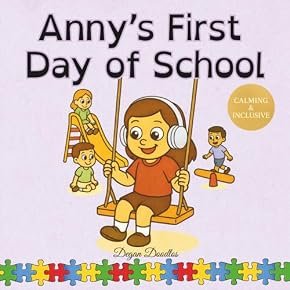
A school routine story can be read before the first day, before returning after a break, or whenever a child is preparing for a change in school life. Families can pause on individual pages, talk about what the character is doing and connect the story to the child’s own experience.
The purpose is not to guarantee that a child will feel comfortable or to replace individual support. Instead, the story can provide a familiar visual reference for moments that may otherwise feel abstract or unpredictable.
Repetition can also be useful. A child may want to hear the same story several times. Familiar illustrations and sequences can make it easier to recognize what comes next.
Teachers and therapists may also use illustrated stories as a conversation starter, giving the child another way to explore school experiences without relying entirely on spontaneous verbal communication.
Gentle illustrated school routine stories created for autistic and neurodivergent children.
A school routine social story for autistic and neurodivergent girls.
View on Amazon
A school routine social story for autistic and neurodivergent boys.
View on AmazonA child does not have to be disruptive to be struggling. Sometimes the child who never asks for help is the child who most needs someone to notice, explain, prepare and make room for a different way of experiencing the classroom.